Raw Material Planning for Manufacturing: Where the Problem Starts and How to Solve It
Production planning is only as good as the data that feeds it. The most critical input is an accurate forecast of finished products, broken down to the raw material level.

Manufacturing companies invest significant money in APS systems and planning tools. Yet they keep running into the same problem: production planning is only as good as the data that feeds it. And the most critical input is an accurate forecast of finished products — broken down to the raw material level. We see a growing need among customers to improve the accuracy of this input for production, and growing investment in this area as a result.
Where Does the Signal for Ordering Raw Materials Actually Come From?
In most manufacturing companies, raw materials are ordered in one of two ways:
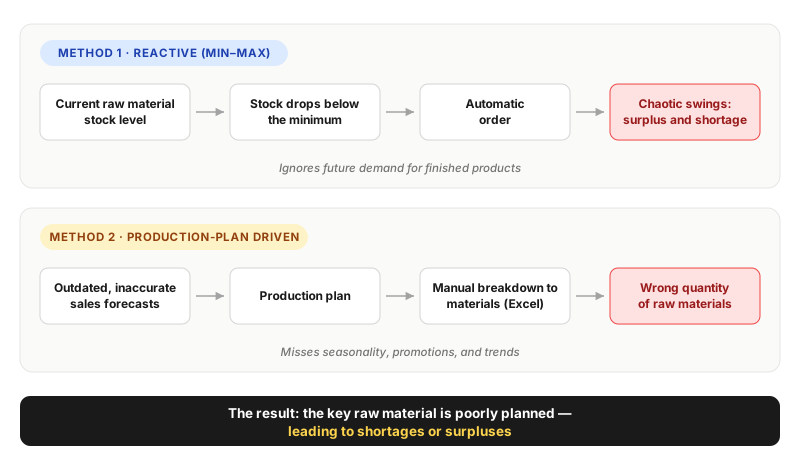
The first approach is reactive: raw materials are ordered based on the current stock level — when inventory drops below a certain threshold, an automatic order is triggered, the so-called min-max ordering method. This approach ignores future demand for finished products and leads to chaotic swings — surplus one time, shortage the next, and in the worst cases even production outages.
The second approach is driven by the production plan: the buyer receives a production plan and derives the raw material requirements from it manually or semi-automatically. The problem is that the production plan is based on forecasts that are often outdated, inaccurate, or completely ignore seasonal fluctuations, promotional campaigns, and trends.
Neither of these approaches is ideal. The result is that the raw material from which finished products are made — and which is therefore the company’s main source of revenue — is poorly planned, leading to shortages or surpluses.
What Does It Mean to Misorder a Raw Material With an Expiration Date?
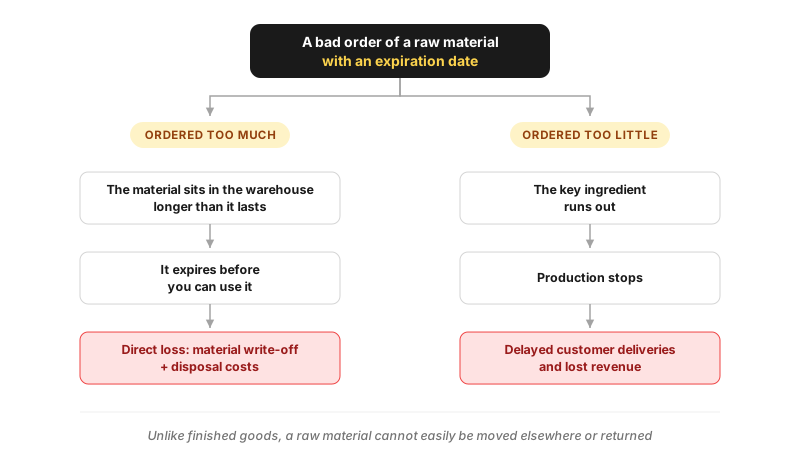
With regular goods, a bad order can be unpleasant — tied-up capital, an overfilled warehouse. With raw materials of limited shelf life, the situation changes dramatically.
Examples from practice:
-
A food manufacturer orders too much flour based on an overestimated spring demand. The raw materials expire before they can be used — a direct loss in disposal costs and in the material itself.
-
A pharmaceutical manufacturer underestimates winter demand, for example for a flu medication — the active ingredient runs out. Production stops and customer deliveries are delayed by weeks.
-
A cosmetics manufacturer lacks an accurate outlook for a new promotional campaign. They order the standard quantity of an ingredient — and in the middle of the campaign discover that the quantity of product produced isn’t enough.
A bad order of a raw material with an expiration date therefore has a double effect: either you needlessly invest money in inventory that ends up in a dumpster, or you lose revenue because you couldn’t produce. And unlike finished goods, a raw material can’t easily be moved elsewhere or returned.
APS Systems Are Great Tools — But They Need the Right Input
Modern APS (Advanced Planning and Scheduling) systems are powerful tools. They can optimize capacities, sequence the production queue, plan line changeovers, and work with material and workforce constraints. But none of them is a planning tool that precisely determines the input. If the production plan is based on an inaccurate or delayed input forecast, the APS system will do an excellent job planning how to produce — but most likely the wrong quantity.
Where exactly does the problem arise?
-
The forecast of finished products is created manually in Excel, or it’s a simple historical average of the same period last year or of recent weeks — without capturing seasonality, trends, and external factors.
-
The forecast isn’t broken down to the raw material level — the bill of materials (BOM) exists in the ERP, but the link to an accurate forecast is missing.
-
Planning happens in weeks or months — demand changes daily, the production plan changes once a week, and raw material purchasing happens with a delay.
-
Promotional campaigns, new products, and seasonal fluctuations aren’t reflected in the forecast — and therefore not in raw material purchasing either, so the buyer orders raw materials based on their usual judgment.
The paradox of modern manufacturing: companies invest hundreds of thousands to millions in APS systems and ERP platforms, but the input data for these systems is old, inaccurate, and assembled by hand.
The Solution: A Forecast Broken Down to Raw Materials
The right approach to managing raw materials starts in a different place than where most companies look for it — not in the raw material warehouse, but in the sales forecast of finished products.
How it works in practice:
-
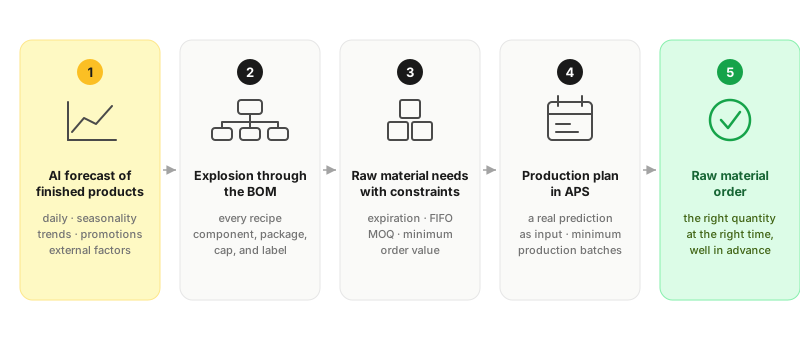
The AI forecast predicts demand for every finished product — daily, taking into account seasonality, trends, promotional campaigns, external factors, and logistics data such as MOQ, minimum order value, and expiration dates.
-
The forecast is automatically exploded through the BOM (bill of materials) into raw material requirements — every recipe component, every package, cap, or even label.
-
The system takes raw material expiration into account — it proposes orders so that raw materials are consumed on time, not stockpiled. We work with FIFO (first in, first out) warehousing logic.
-
An accurate forecast of finished products is the right input for APS — the system then plans production based on a real prediction, the production plan generates precise raw material requirements taking minimum production batches into account, and only then does the purchasing department order the right quantity at the right time.
-
Buyers see proposed orders well in advance — not the day before a raw material runs out.
Conclusion
Proper management of raw materials starts much earlier than the order sent to the supplier — it starts with an accurate sales forecast of finished products. Companies that build this forecast on AI instead of Excel or historical averages achieve:
- A significant reduction in write-offs and raw material expiration.
- Elimination of production outages caused by material shortages.
- Better use of APS systems — finally with the right inputs.
- Savings of dozens of hours per month in the purchasing and planning process.
- Freed-up capital tied in excess raw material inventory.
Want to see how it works in practice?
Check out www.goodstock.ai — an AI solution for demand forecasting and inventory management automation that helps manufacturing companies optimize raw material purchasing without the risk of outages and unnecessary write-offs.